
OEM or ODM for a Kids-Safe Line: The Practical Trade-Offs
The OEM-versus-ODM decision is usually framed as a choice between doing more yourself and buying more from the factory, with ODM implicitly treated as the beginner's option. That framing is unhelpful on a kids-safe line, where the decisive question is different: which party holds the competence to defend the product's safety and performance claims? OEM gives the brand more control over the formula and the pack, and more responsibility for proving them. ODM moves design and development to the partner and buys speed, at the cost of owning less of the result. Both are legitimate; the trade is real.
Key takeaways
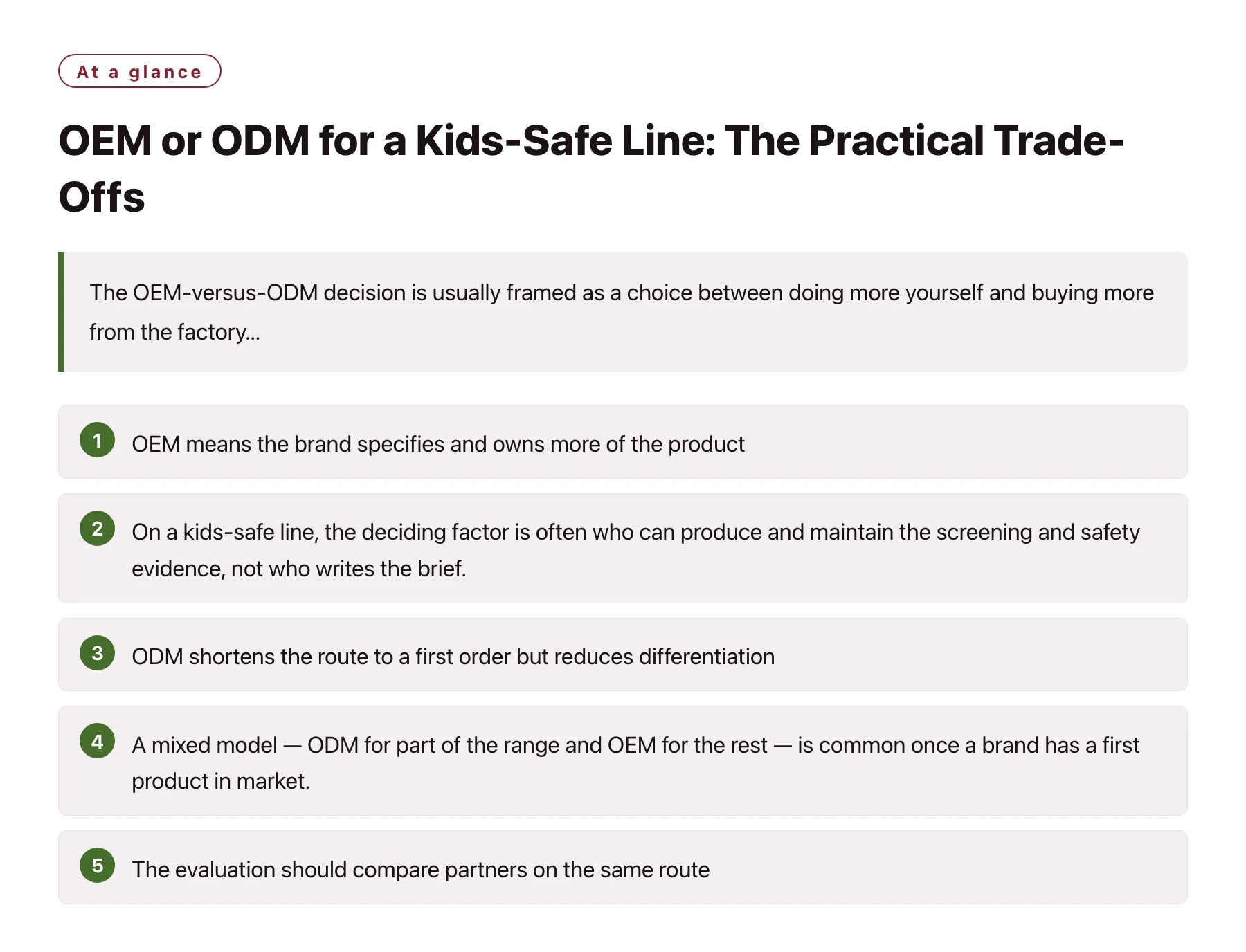
- OEM means the brand specifies and owns more of the product; ODM means the partner designs and supplies it, usually from a developed concept.
- On a kids-safe line, the deciding factor is often who can produce and maintain the screening and safety evidence, not who writes the brief.
- ODM shortens the route to a first order but reduces differentiation, because the underlying development work may also serve other buyers.
- A mixed model — ODM for part of the range and OEM for the rest — is common once a brand has a first product in market.
- The evaluation should compare partners on the same route, because an OEM quote and an ODM quote answer different questions.
Buyers often arrive at a supplier evaluation with a preference already formed: ambitious brands want OEM, budget-conscious brands accept ODM. The preference tends to survive until the first launch, when the real constraints appear — sampling rounds, testing time, minimum quantities and the paperwork each market demands.
This article sets out the trade-offs as they appear in practice on a kids-safe format, and then describes how to compare partners without comparing incompatible offers.
The two routes, dimension by dimension
| Dimension | OEM route | ODM route | Why it matters for a kids-safe format |
|---|---|---|---|
| Who designs the fragrance | The brand briefs; the perfumer develops to that brief, and the brand approves each round | The partner develops from its own library and concept work, with the brand selecting | A dedicated brief is easier to screen against a specific intended user, while a library scent has to be re-screened for the new category |
| Formula ownership | Usually the brand, subject to the terms agreed | Usually the partner, with the brand holding a licence or an exclusive supply arrangement | Ownership affects who can answer a regulator's question years later and who maintains the screening record when standards change |
| Time to first order | Longer, because development and sampling sit on the critical path | Shorter, because development is largely done before the conversation starts | Speed matters most when the format is a test; the trade is that testing still cannot be compressed |
| Differentiation | Higher, since the scent and the pack can be specific to the brand | Lower by default, unless the partner agrees exclusivity for the scent or the pack | A distinctive format is easier to defend in a crowded category, but distinctiveness is not a safety argument in itself |
| Cost profile | Development and sampling are paid for up front; unit cost depends on volume and pack | Development is absorbed into the product price; unit cost is often more predictable at small volumes | For a first order, the ODM route usually lowers the cash needed to start, which matters more than unit cost at low volume |
| Documentation and evidence | The brand specifies what it needs and holds the technical file | The partner supplies its standard document set, which may need extending | Whichever route you choose, the brand selling the product carries the market obligation, so the document set is the brand's problem |
The table is not a scorecard. It is a list of the places where the two routes behave differently, and each brand has to decide which of those places it can afford to be weak in.
Evaluating a partner without comparing incomparable offers
The most common evaluation mistake is to collect quotes from a mix of OEM and ODM suppliers and rank them by unit price. Those prices describe different bundles of work: one includes development, the other assumes it. The comparison only becomes meaningful once each offer is normalised to the same scope, which usually means asking the ODM supplier what a dedicated development would add, and asking the OEM supplier what a library scent would remove.
The second mistake is to treat development capability as a proxy for production quality. They are related but not identical. A partner may formulate well and fill adequately, or the reverse. That is why the evaluation should look at both ends of the pipeline, which is exactly what a request for fragrance OEM/ODM services is meant to surface: not a single capability, but a chain that runs from brief to sealed bottle.
The third mistake is to assume that a larger supplier is always the safer choice. On a first kids-safe line, the more useful question is who will answer the phone when a screening question arises, and whether the person who answers has the authority to change a formulation decision. Scale does not guarantee that; process discipline does.
Ask how the partner handles a restricted material
Give the supplier a concrete scenario: a material in the proposed formula faces a change in its permitted use level for your category. Ask what happens next, who is notified and what the timeline is. The fragrance houses that supply materials publish standards and updates that manufacturers rely on [1], and a partner that follows those updates has a rehearsed answer. A partner that improvises has told you something about the next ten years.
Ask who maintains the technical file
On an ODM arrangement, the file is often assembled by the partner and handed over as a package. On an OEM arrangement, the brand usually holds the pieces and assembles them. Neither is wrong, but the answer determines whether the brand needs a regulatory consultant, a formulation record and a document management habit. Buying that capability is fine; discovering it is needed three weeks before launch is not.
Check where the process actually runs
Ask which site compounds, which site fills and which site decorates. A partner with everything in one place removes the transfers that cost time and create the possibility of a mix-up. Industry coverage of formulation and manufacturing practice regularly documents how much of a project's risk sits in those handoffs [2], and buyers who ask the question early tend to have fewer surprises at the pilot stage.
The mixed model, and when it makes sense
Most brands do not stay in one route. A first launch often uses a partner's developed concept to reach market quickly and inexpensively. The second or third product is frequently developed to a specific brief, because the brand has learned what sells and wants something it can defend as its own. Moving between the two is normal, and it is easier when the same partner can do both.
Consolidating the two routes with one partner is one reason buyers look for a factory that handles fragrance R&D and production rather than assembling a chain of specialists. The advantage is continuity: the formulation history, the retained samples and the screening records stay under one roof, and a switch from an ODM product to an OEM development does not require rebuilding the record from scratch.
The page describing Xuelei sets out what that consolidation typically includes, and it is worth reading as a checklist of questions rather than as a promise.
There is a limit to consolidation. If the brand needs a capability the partner does not have — a specific decoration technique, a particular pack format, a market-specific certification — the chain has to extend somewhere. The practical approach is to consolidate the parts that carry risk and keep the parts that are easy to buy separately, in separate hands.
A last consideration that rarely appears in comparison tables: how the partner treats its own material knowledge as a public asset. A manufacturer that runs a museum and a training programme is effectively publishing its materials expertise, which is a useful signal about whether it can explain a formulation decision in plain language. The Xuelei's scent museum and the associated teaching work are examples of that kind of disclosure, and reading through them tells a buyer more about how a technical conversation will go than a list of equipment ever will. Use the museum as a prompt for questions — how materials are selected, how they are restricted, how they are explained to consumers — and bring those questions to the evaluation already set out above.
Sources
- dsm-firmenich —— A global fragrance, flavour and nutrition company; public information on perfumery, ingredients and sustainability programmes.
- Cosmetics & Toiletries —— A technical magazine for cosmetic formulators, covering ingredients, formulation science and testing methods.
Frequently asked questions
Is OEM always more expensive than ODM?
Not at scale, and not always at small volume either. The difference is when you pay: OEM front-loads development and sampling costs, while ODM absorbs those into a product price. Compare total cost to launch rather than unit cost alone.
Can we get exclusivity on an ODM scent?
Sometimes, and it is worth asking explicitly. Exclusivity may be limited by territory, by category or by time, and it usually carries a volume commitment. Whatever is agreed should be written into the supply terms rather than assumed from the sales conversation.
Which route is better for a first kids-safe product?
If speed and cash matter most, an ODM route with a re-screened library scent is a reasonable start. If the format is central to the brand's positioning, OEM development avoids the risk that another brand ends up selling something very similar.
How many suppliers should we evaluate?
Two or three on the same route is enough. More than that dilutes the depth of each conversation, and comparing offers built on different assumptions is the main source of confusion at this stage.
What single question reveals the most about a partner?
Ask who is accountable when a screening requirement changes after the formula is approved. The answer names a role, a process and a timescale, and it tells you whether the partner's compliance story is a system or a sentence.
Now booking 2025 & 2026 brides.
Sixty-eight percent of this season's dates were reserved by January. Hold a conversation with the studio before the calendar closes.
Check My Date & Get a Quote